Article
Calorie Surplus vs. Deficit: Key Differences
Calories decide weight: 200–300 kcal surplus for muscle, 300–500 kcal deficit for fat loss; prioritize protein and strength training.

Your calorie target should match your goal: eat above maintenance to gain, below maintenance to lose fat, and at maintenance to stay about the same. In most cases, a small surplus of 200–300 calories works for muscle gain, while a deficit of 300–500 calories works for fat loss. If you push too far in either direction, you often get more fat gain, more hunger, lower energy, or muscle loss.
Here’s the short version:
- Surplus: best for muscle and strength gain
- Deficit: best for fat loss
- Maintenance: best for stable weight, diet breaks, or body recomposition
- Protein matters: aim for 1.6–2.2 g/kg or 0.7–1.0 g/lb
- Training matters: keep lifting to help grow or keep muscle
- Track trends, not one day: use 7-day average weight, waist size, and gym performance
- Adjust slowly: change calories by 100–200 only after 2–4 weeks of trend data
Mastering Your Calorie Equation: Surplus vs. Deficit
Quick Comparison
| Approach | Calories | Main Goal | Common Starting Range | Main Tradeoff |
|---|---|---|---|---|
| Surplus | Above maintenance | Muscle/weight gain | +200 to +300 calories/day | Some fat gain |
| Maintenance | At maintenance | Weight stability | Around TDEE | Slower visible change |
| Deficit | Below maintenance | Fat loss | -300 to -500 calories/day | Hunger, lower energy |
I’d sum it up like this: calories decide whether your weight goes up, down, or stays flat, but protein and lifting help decide whether that change is more muscle or more fat.
Calorie Balance Basics: Surplus, Deficit, and Maintenance
At any given time, you’re in one of three calorie states: surplus, deficit, or maintenance. Which one you’re in matters, because each state lines up with a different goal.
What a calorie surplus means
A calorie surplus means you eat more than your body burns in a day. Your body stores that extra energy as fat, though with resistance training, part of it can help build muscle. In most cases, a small surplus of 200–300 calories above maintenance is a solid range for muscle gain with less fat gain.
What a calorie deficit means
A calorie deficit means you eat less than your body burns. To make up the gap, your body uses stored energy, mainly body fat. For many people, a daily deficit of about 300–500 calories is a practical place to start. Go too aggressive, and you don’t just lose fat - you can lose lean muscle too.
What maintenance looks like day to day
Maintenance sits in the middle. You eat about the same number of calories as your body burns each day, so your weight stays about the same. This is your total daily energy expenditure, or TDEE, and it includes resting metabolism, digestion, and physical activity. Think of maintenance as your starting line. From there, you either eat above it for gain or below it for fat loss.
Here’s the quick comparison:
| State | Calorie Adjustment | Primary Goal |
|---|---|---|
| Surplus | 200–500 kcal above maintenance | Muscle or weight gain |
| Maintenance | Eat at TDEE | Weight stability |
| Deficit | 300–500 kcal below maintenance | Fat loss |
With those three calorie states set, the next step is looking at how each one shapes muscle gain, fat loss, and what day-to-day eating tends to look like.
How a Calorie Surplus and Deficit Differ
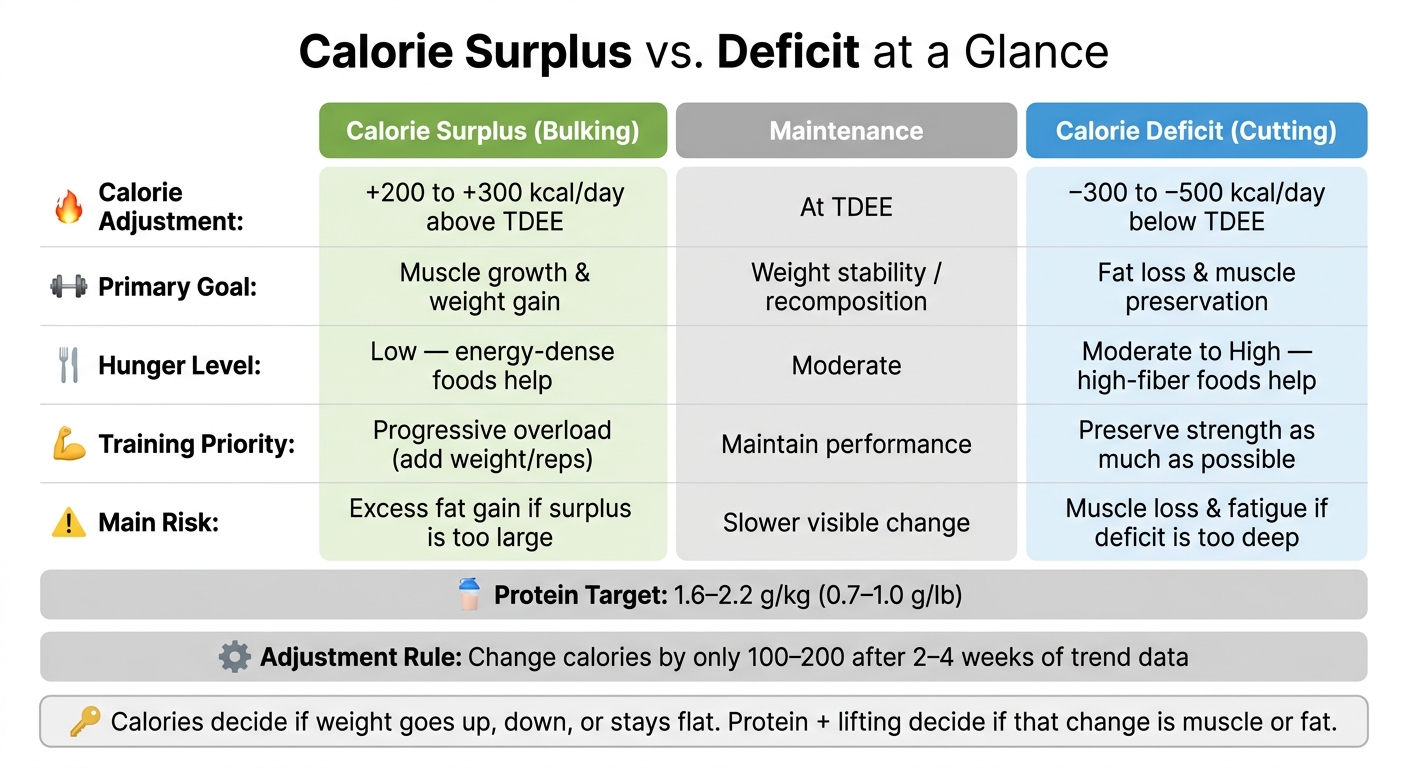
Calorie Surplus vs. Deficit: Side-by-Side Comparison Chart
A surplus helps you build. A deficit helps you cut. Maintenance sits in the middle, and these two approaches move you in opposite directions.
Side-by-side comparison table
| Feature | Calorie Surplus (Bulking) | Calorie Deficit (Cutting) |
|---|---|---|
| Primary Goal | Muscle growth and weight gain | Fat loss and muscle preservation |
| Typical Approach | Smaller, controlled increase above maintenance | Moderate, controlled decrease below maintenance |
| Expected Outcome | Muscle gain, plus some fat gain | Lower body fat while preserving muscle |
| Best Use Case | People who are lean and want to add size or strength | People with more body fat who want to lean out |
| Training Priority | Progressive overload - adding weight or reps | Preserving strength as much as possible |
| Hunger Level | Generally lower; energy-dense foods may help, which you can track using an AI calorie counter | Moderate to high; high-volume, high-fiber foods help |
| Main Risk | Excess fat gain if the surplus is too large | Muscle loss and fatigue if the deficit is too deep |
That gap shapes both your results and the tradeoffs.
Calorie surplus for muscle gain and weight gain
Use a surplus when your main goal is adding muscle or strength. A lean bulk - 200–300 calories above maintenance - usually gives your body enough fuel to support muscle growth without piling on extra fat.
More food doesn’t always mean more muscle. In a study of trained lifters, a 15% surplus didn’t produce meaningfully more muscle than a 5% surplus, but it did lead to more fat gain. So yes, a larger surplus can push scale weight up faster. The catch is that more of that gain is likely to be fat, not muscle.
Calorie deficit for fat loss while keeping muscle
Use a deficit when fat loss is the top goal and you want to keep as much muscle as you can. The sweet spot is usually moderate - about 300–500 calories below maintenance. Pair that with protein at 1.6 to 2.2 grams per kilogram of bodyweight and keep lifting through the cut.
Going too hard tends to backfire. Faster weight loss can increase the risk of losing muscle, which is why staying around 0.5–1% of bodyweight lost per week is a smart target for keeping lean mass. Next up is the price you pay with each method.
Pros and Cons of Each Approach
This section shows what each approach gives you - and what it costs.
Pros and cons comparison table
| Approach | Main Benefits | Main Drawbacks |
|---|---|---|
| Calorie Surplus | Muscle growth, stronger lifts, better workout energy | Some fat gain is likely; aggressive surpluses can raise insulin resistance risk |
| Calorie Deficit | Lower body fat, better health markers tied to excess body fat | Hunger, lower energy, risk of muscle loss if the deficit is too deep |
The difference is straightforward: a surplus helps you build, while a deficit helps you lose.
Benefits and downsides of a calorie surplus
A calorie surplus supports muscle protein synthesis, muscle repair, growth, and recovery. If your main goal is adding muscle, it gives your body more room to do that work.
The catch is simple: some fat gain is tough to avoid. If you eat more calories than your body can use for growth, the extra gets stored as fat. And when the surplus gets too big, fat gain can outpace muscle gain. Research on trained lifters found that a 15% surplus did not lead to meaningfully more muscle than a 5% surplus, but it did lead to more fat gain. So yes, a surplus can help you grow - but pushing it too far usually means adding extra fat along the way.
Benefits and downsides of a calorie deficit
A calorie deficit is the fastest way to reduce body fat, often managed using the best food calorie app, and it can improve some health markers linked to excess body fat. When fat loss is the top goal, this is the tool that fits.
But deficits come with friction. Hunger hormones go up in a deficit, energy often drops, and training can feel harder than usual. If the deficit gets too deep, the risk of muscle loss goes up too. Aggressive cuts can also slow metabolism and make fat loss tougher over time.
Once you see the tradeoffs clearly, choosing between the two gets a lot easier.
How to Choose the Right Approach for Your Goal
A simple decision framework for fat loss, muscle gain, or maintenance
Start by matching your calorie target to the goal you care about right now.
- Fat loss: use a moderate calorie deficit
- Muscle gain: use a modest calorie surplus
- Maintenance: stay in the middle when you want stability, a reset, or a phase where you try to lose fat and build muscle at the same time
Your training background matters too. If you’re a beginner or you’re coming back after time away, you can often build muscle at maintenance. More advanced lifters usually need a surplus to make solid progress.
There’s also a practical side to this. If your energy is dragging and your workouts are stalling, pushing through another week of restriction may not be the best move. A short maintenance break can help more.
What to track so adjustments are based on data
A lot of people change course too soon. That’s where things go off the rails.
Give any approach 2–4 weeks before you change it. Day-to-day scale jumps from water, sodium, and glycogen are normal. They don’t show actual progress.
Track a small set of numbers and keep it simple:
- Your 7-day average body weight
- Your waist measurement
- Your training performance, including weight, reps, and sets
In a deficit, the aim is to keep strength steady while your waist gets smaller. In a surplus, you want gym performance to move up while your waist stays fairly steady.
If your weekly average weight has stayed flat for 2–3 weeks during a cut, reduce intake by 100–200 calories. If you’re bulking and your waist is increasing faster than your lifts, scale the surplus back.
Keep protein high and consistent.
Using Welling to stay on track without tedious logging

Welling makes logging easier with photo, chat, and voice input, along with personalized calorie guidance and macro tracking. That gives you a simpler way to adjust from data instead of guesswork.
Once your target is set, the next step is avoiding the common mistakes that stall progress.
Common Mistakes That Slow Progress
Once you’ve used calorie tracking apps to set your target, a few common mistakes can bring progress to a crawl.
Starting with too large a surplus or deficit
Start near maintenance, not miles away from it. A small deficit helps with fat loss. A small surplus helps with muscle gain. Go too far in either direction, and you usually get more fat gain, more hunger, and more fatigue without better results.
A sensible deficit is 10–20% below maintenance. That lines up with a safe rate of loss of about 0.5–1% of your body weight per week. Push harder than that, and the odds of more hunger, lower energy, and slower progress go up. On the other side, surpluses above 500 calories a day can lead to extra fat gain without more hypertrophic benefit.
Calories point you in the right direction. Protein and lifting decide what happens to your body.
Ignoring protein and resistance training
Calories affect whether you gain or lose weight, but protein and resistance training shape what you gain or lose. That’s the whole game.
In a deficit, they help you hold onto muscle. In a surplus, they influence how much of that extra energy supports muscle growth instead of just adding body fat. A good target is 1.6–2.2 g of protein per kg of bodyweight (about 0.7–1 g per pound) and lifting at least twice a week.
Changing calories too soon
This is where a lot of people get tripped up. One high weigh-in can feel like failure. One low weigh-in can make it seem like everything is clicking. But day-to-day scale changes often come from water, glycogen, sodium, stress, and sleep.
So don’t judge your plan by a single day. Watch the trend.
Wait 2–4 weeks before deciding a plan isn’t working. Track your 7-day average weight, your waist measurement, and your training performance together. If your weekly average weight has stayed flat for 2–3 weeks during a cut, lower intake by 100–200 calories. If you’re bulking and the scale hasn’t moved in that same stretch, bump calories up by 100–200 calories. Small adjustments work better when the trend is clear.
Conclusion: The Key Difference Is the Goal
Choose the calorie state that fits your goal: surplus for gain, deficit for loss, and maintenance for stability. Once that’s clear, the next step gets a lot simpler: apply it the same way week after week.
For muscle gain, use a small surplus and lift on a steady schedule. For fat loss, use a moderate deficit and keep protein high. Then track 7-day weight averages and waist size. Adjust calories by 100–200 only after 2–4 weeks of trend data.
If you want less manual logging, tools like Welling can do the tracking for you. Welling can make logging easier and help you adjust based on real trends, not guesswork. Match the method to your goal, keep protein high, train on a steady basis, and watch the trend - not the day-to-day noise.
FAQs
How do I find my maintenance calories?
Maintenance calories are the amount you eat to keep your weight steady.
Once you know that number, the next step is pretty simple:
- Use a calorie deficit if your goal is fat loss.
- Use a small calorie surplus if your goal is muscle gain.
A common target for a deficit is about 500–600 calories per day below maintenance, or roughly 10–20% below your maintenance level.
For a conservative lean bulk, a common target is about 350–480 calories per day above maintenance, or around 5–10% above maintenance.
Can I build muscle in a calorie deficit?
A calorie deficit usually leads to fat loss and weight loss because you take in fewer calories than your body burns. A calorie surplus means you eat more than you burn, which usually leads to weight gain, mostly from fat.
If your goal is muscle gain, a small surplus plus resistance training is usually the better move. If your goal is weight loss, use a modest deficit and adjust it based on your weekly trend. Welling can help you track calories and gives you daily targets and coaching.
How long should I wait before adjusting calories?
Use a calorie deficit to lose fat, a calorie surplus to build muscle, and maintenance to keep your weight about the same.
A deficit means eating fewer calories than your body burns. A moderate deficit of about 500–600 calories per day is often used for steady fat loss.
A surplus means eating more calories than you burn. Keep it modest - about 5–10% above maintenance, or roughly 350–480 calories per day - to help support muscle gain while keeping fat gain in check.